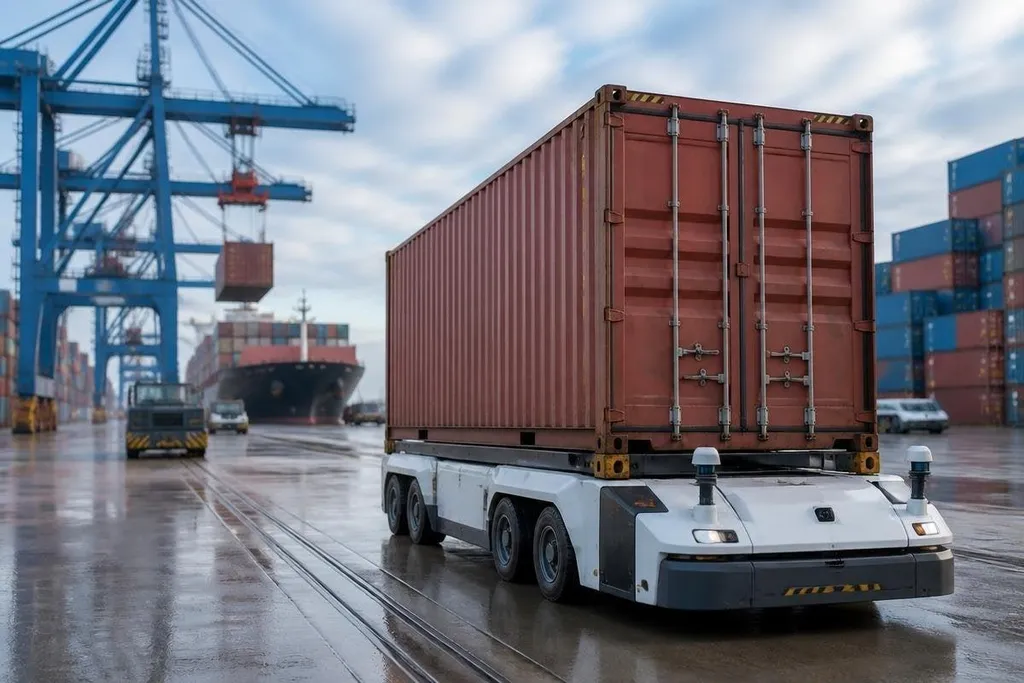
A cargo port is a chain of handoffs. A box leaves a ship at a quay crane, moves onto a yard vehicle, then reaches a storage block; one delay can hold up the work that follows.
Port robots could cut waiting time by moving containers, checking equipment, and sending live location data between these steps. The harder question is whether they can keep working safely when people, trucks, cranes, weather, and damaged cargo share the same space.
Quick read
- Yard robots can move containers between quay cranes and storage areas.
- Sensors can help machines detect vehicles, people, container edges, and blocked routes.
- The main test is steady work through handoffs, charging stops, safety checks, and bad weather.
Where robots can save time
The clearest use is container movement inside the yard. An autonomous terminal tractor can carry a container between the quay and a storage area without a driver in the cab. A fleet control system can assign routes and send another vehicle when one robot needs to charge or stop for inspection.
That only helps if the handoff is ready. The crane must place the container correctly, the robot must confirm that it has a load, and the yard system must know where the container belongs. A robot waiting beside a crane still costs time, even if it drives without a person onboard.
Robots can also work around the main cargo flow. Camera systems may check container numbers or spot damage before a box moves farther into the yard. Inspection robots can examine pavement, rails, fences, or crane parts while cargo vehicles keep moving, though each task needs a clear way to report faults to a human operator.
The sensors and control systems behind the work
A port robot needs more than a route on a map. LiDAR uses laser pulses to measure nearby objects, while cameras can read signs, container markings, and lane edges. Position data helps the robot keep track of its place when metal structures or stacked containers block signals.
The control system must then combine those inputs and choose a safe action. If a person enters the route, the robot may stop. If a container sits outside its expected position, the system should ask for a check instead of forcing the pickup.
This is where automation affects cargo speed in a less obvious way. A cautious stop can protect people and equipment, but too many false stops can slow the yard. Port operators need records that explain why robots stopped, how long they waited, and what fixed the problem.
A port trial means little without the robot, terminal, task, and result beside it. Port automation reporting from Robot24.com can give you those details before you judge a machine’s claim against work at a live site. That record leads into the rollout limits below.
What can slow the rollout
Port roads are not closed test tracks. Trucks may take a wrong lane, a container may arrive with damaged fittings, and rain can affect cameras or road markings. Salt, dust, vibration, and uneven ground also add work for maintenance teams.
Charging creates another limit. A battery robot may need a planned stop, a spare battery, or a charging point that does not block a traffic lane. The control system must fit those stops around crane work and vessel schedules.
People remain part of the system. Operators may need to take control, clear a blocked route, approve an unusual container move, or inspect a robot after contact with an obstacle. A port that lacks clear rules for those handoffs can move the delay from driving to supervision.
A practical port robot check
Before a port buys or expands a robot fleet, check these points:
- Map the handoffs: record where cranes, vehicles, storage blocks, and staff exchange control of each container.
- Count safe stops: measure how often the robot pauses and how long a person takes to clear each case.
- Test bad conditions: run the system with rain, glare, dust, blocked lanes, and containers outside their planned position.
- Plan charging: place charging points so a stopped robot does not block cranes or traffic.
- Keep manual control: give trained staff a clear way to stop, redirect, and inspect every machine.
- Track the full move: start the clock at crane pickup and stop it at confirmed placement, rather than measuring only driving time.
The last measure matters most. A robot can drive smoothly and still fail to speed cargo handling if the crane handoff, software check, or human approval takes longer than the trip.
The next useful proof will come from ports that publish full move times, stop records, safety events, and maintenance needs. Until those figures are available for a specific site, port robots are a practical option to test in a defined route, not a promise to apply across the whole yard.